
Your Financial Advisor’s Credentials Are Probably Meaningless
Topic: Behavioral Finance

Applies to: Med Student · Resident · Early Career · Mid Career · Late Career · Retired
The 2-Minute Version
Only three financial credentials matter: CFA, CFP, and CPA. Everything else is noise.
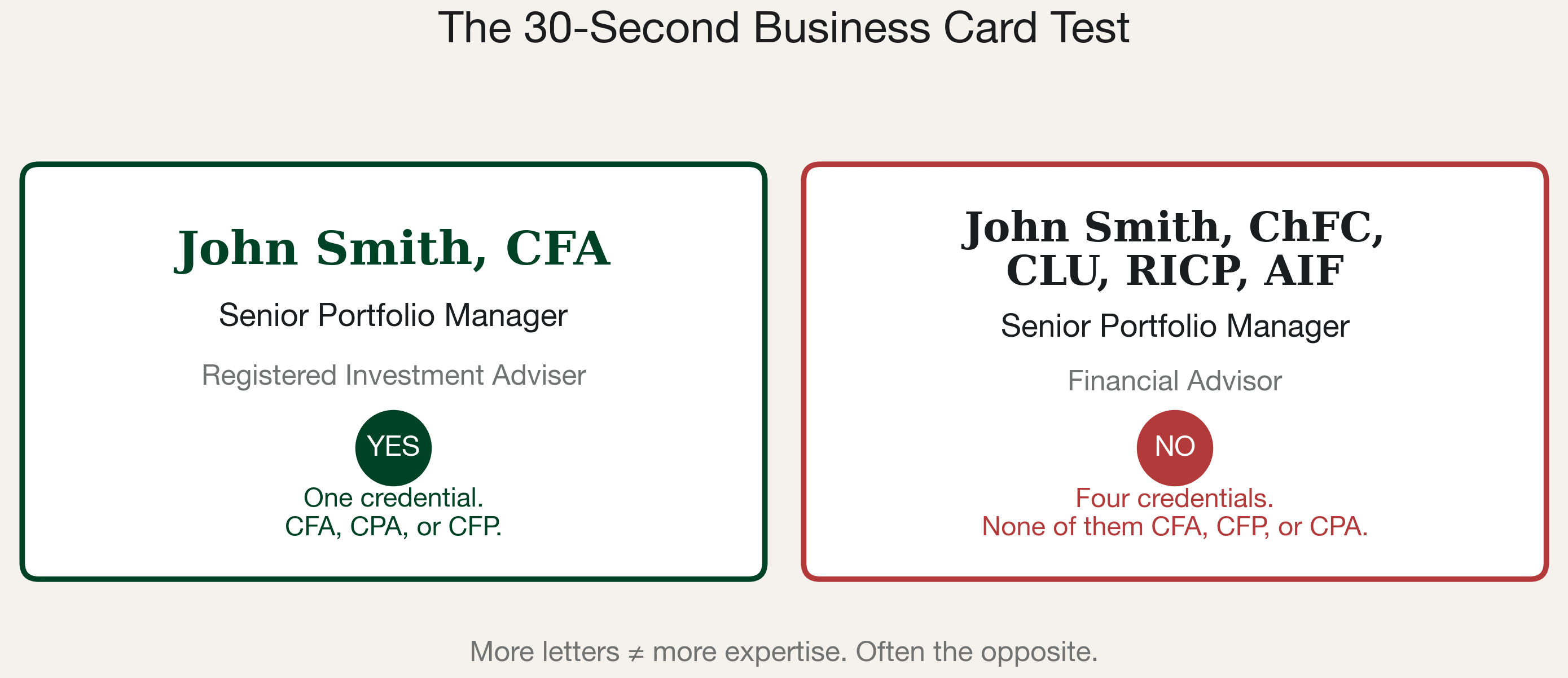
Credential stacking is a red flag, not a strength. Nobody at Goldman or Blackstone lists four designations.
Evaluate your current advisor. Either go DIY for average, or pay up for truly exceptional. The worst spot is paying for average you could get yourself.
You’re at a physician financial planning dinner. The advisor hands you a business card: “John Smith, ChFC, CLU, RICP, AIF.” Four credentials. None of them CFA, CFP, or CPA.
That should bother you.
The Alphabet Soup Problem
FINRA tracks over 250 financial designations. That’s up 45% from a decade ago. More than half include “certified” or “accredited” in the title. The part that should make you uncomfortable: the titles “Financial Advisor,” “Financial Consultant,” and “Wealth Manager” are completely unregulated. Anyone can use them. No exam. No license. No oversight.
You trained for 11 to 16 years. Passed three USMLE steps. Survived residency. Got board certified. When you see “Certified” on a business card, you instinctively assign it the same weight as your own credentials. That instinct is being exploited.
The CFA requires 900+ hours of study across three exams over 3+ years, with a 44% pass rate per level. The RFC requires zero hours, zero exams, and $350. Both can call themselves “financial advisors.” (Yes, really.)
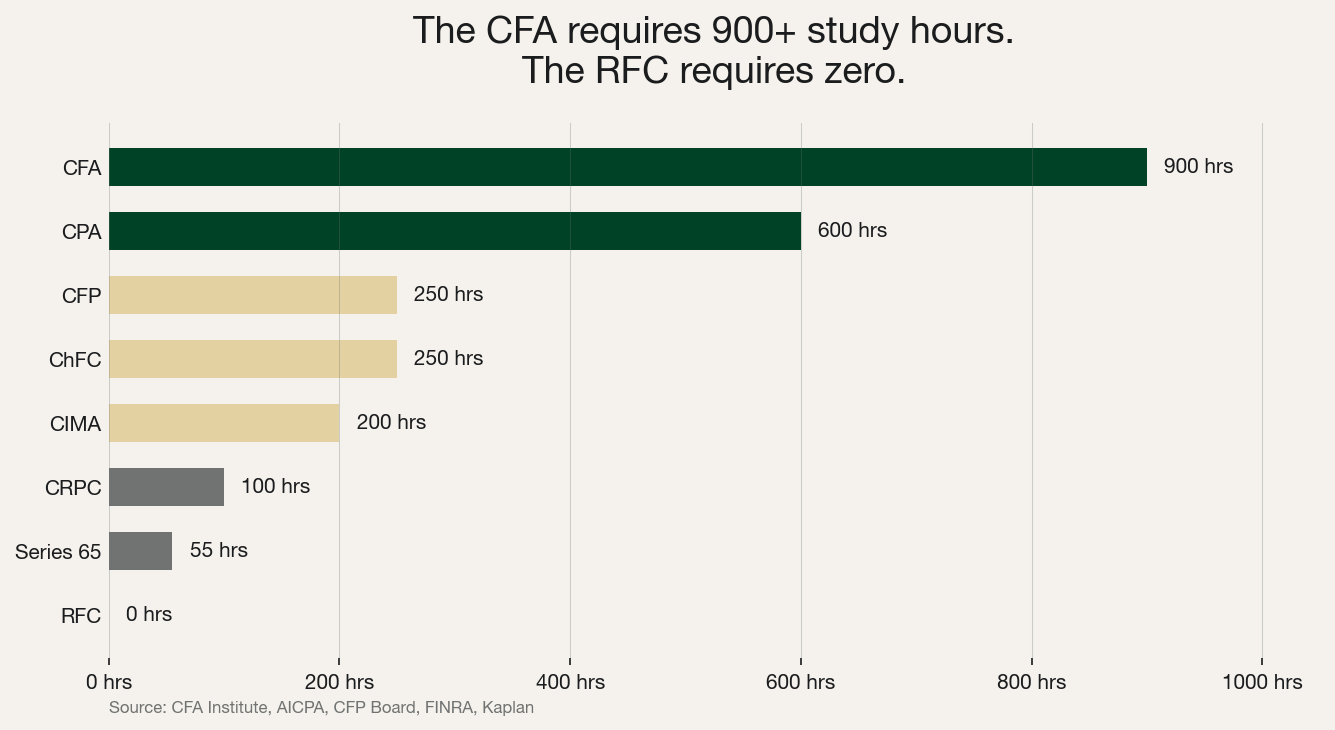
Source: CFA Institute, AICPA, CFP Board, FINRA, Kaplan
What Actually Matters
We think there are exactly three credentials worth respecting: CFA, CPA, and CFP. In that order.
The CFA is the gold standard. The competitive fellowship of finance. Designed to keep people out. The CPA is your boards. Four-part exam, state licensing, continuing education. Essential if your advisor touches anything tax-related. The CFP is graduating medical school. Baseline competence. Table stakes for a financial planner. Not the ceiling.
Here’s the tell nobody talks about: credential stacking is inversely correlated with quality. Look at the top firms in the country. Blackstone. Bridgewater. Goldman Sachs. The people there might list CFA or CPA. Nothing beyond that. It’s people at less reputable firms with less experience who stack four or five designations. Ask yourself: have they spent all their time getting credentials rather than truly learning their craft?
Here’s the full breakdown. Save this.
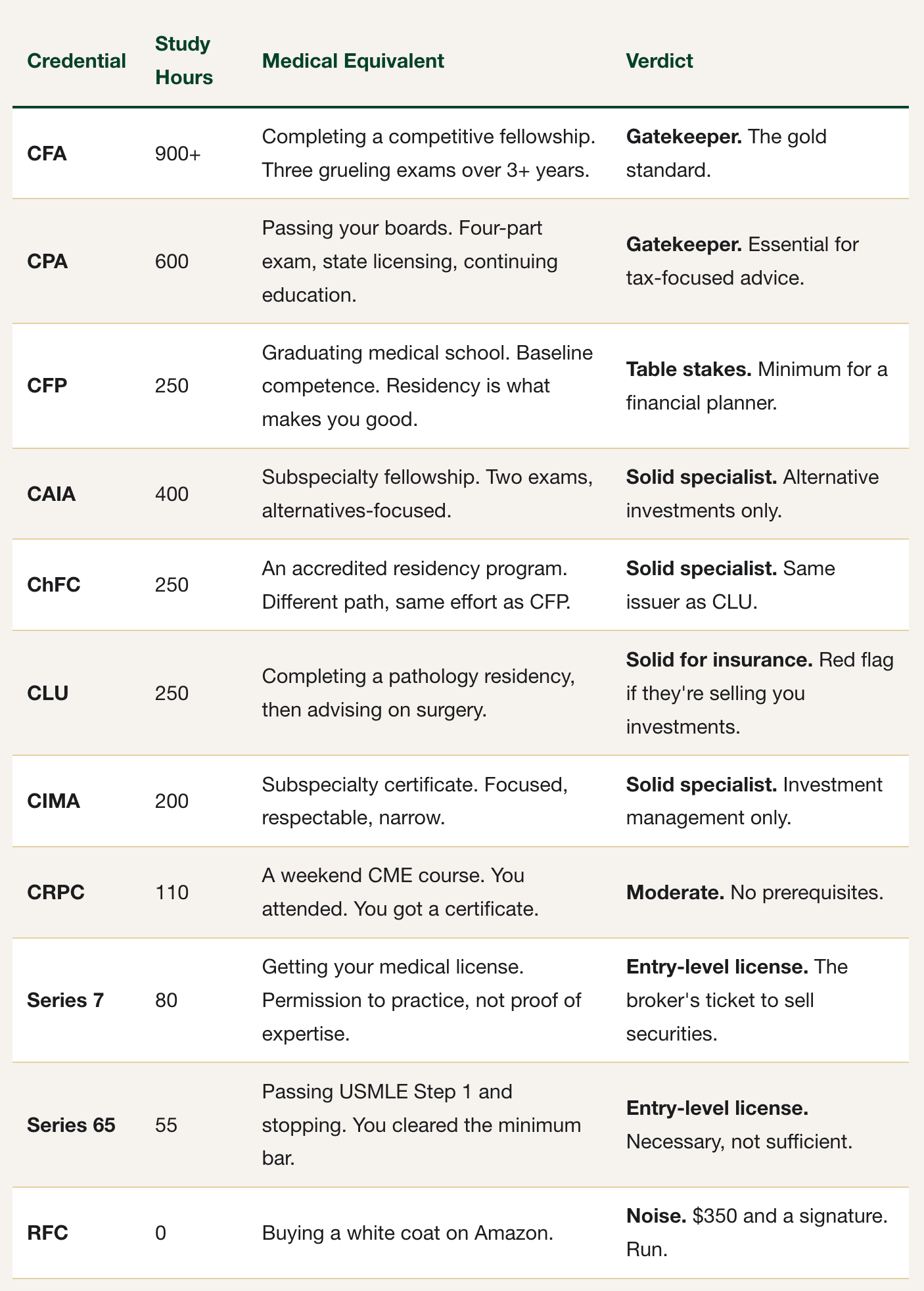
Sources: CFA Institute, AICPA, CFP Board, CAIA Association, FINRA, Kaplan
Only 9% of registered financial professionals hold a CFA. Just 15% hold a CFP. Nearly half hold no rigorous credential at all, per the FINRA 2025 Industry Snapshot. The person managing your money is more likely to have zero meaningful credentials than to hold either of the two that matter most. Let that sink in.
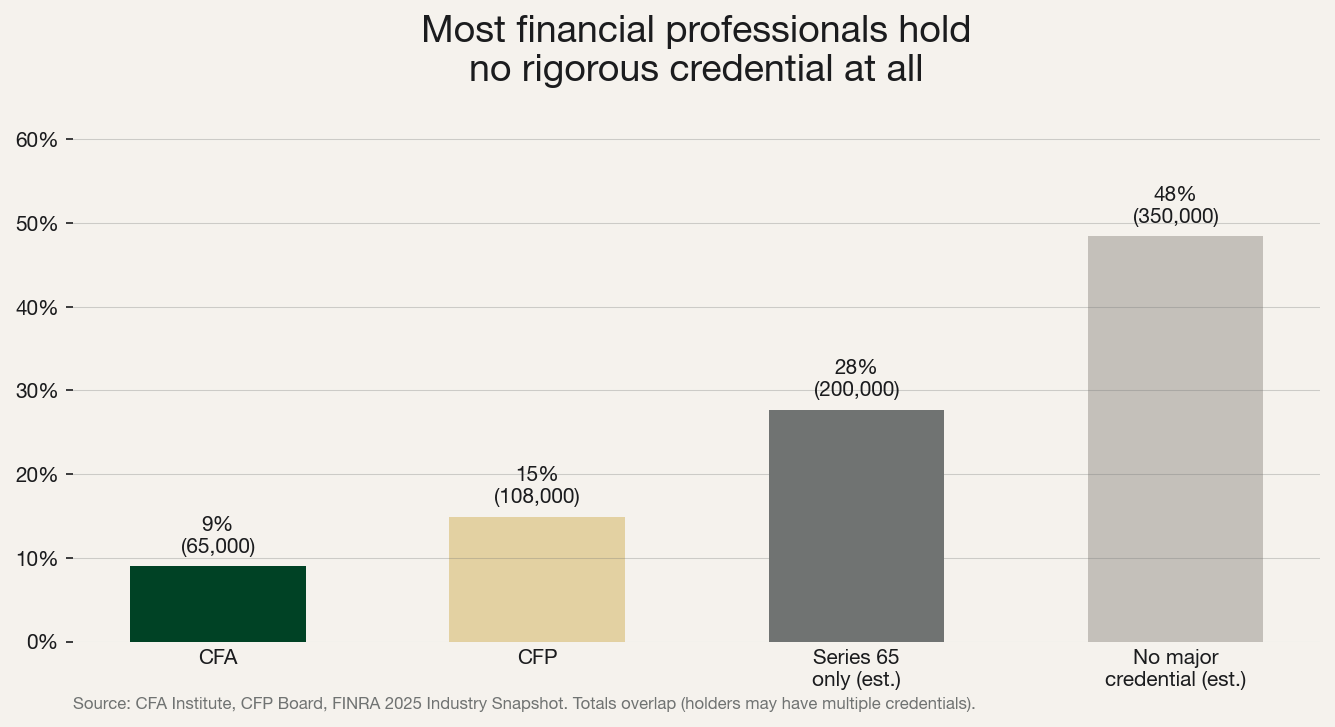
Source: CFA Institute, CFP Board, FINRA 2025 Industry Snapshot
The Move
Be a skeptic. Many of the people in this industry hold themselves out to be much smarter or much more talented than they actually are.
Here’s what we’d do:
First, look up your current advisor on FINRA BrokerCheck and the SEC’s Investment Adviser Public Disclosure database. Check their credentials against the cheat sheet in this issue.
Second, decide what you’re paying for. If you’re getting average service, you’re smart enough to get average on your own for almost nothing. The worst spot is paying for average when you could have done it yourself.
Third, if you have the net worth and connections to access a truly top-tier wealth management firm (one that treats your finances like a single family office), have the conversation. The best plastic surgeon in the world doesn’t charge what a new grad charges. That dynamic exists in finance too.
Rip the Band-Aid off if you need to. Your financial future is too important to outsource to someone whose most impressive credential took a weekend to earn.
Sources
Data
Analysis
Tools
Off the Clock
The Chart We Can’t Stop Looking At
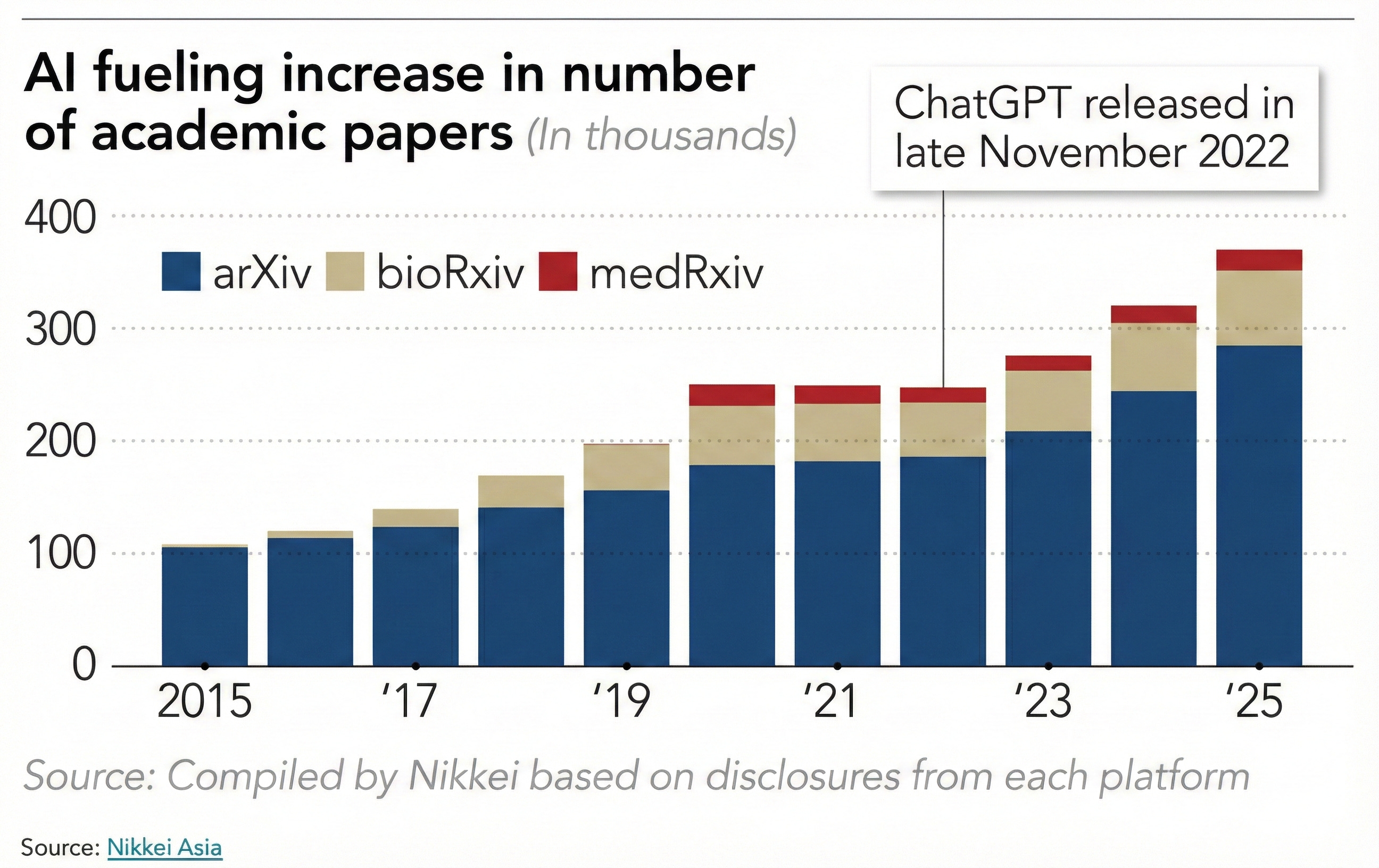
Source: Nikkei Asia, compiled from arXiv, bioRxiv, medRxiv disclosures
Academic paper submissions have nearly tripled since ChatGPT launched in late 2022. medRxiv and bioRxiv are right in the middle of it. If you’re a physician relying on the literature to guide clinical decisions, the signal-to-noise ratio just got a lot worse. We’re watching this closely.
Noticed it in your own reading? Reply and tell us what you’re seeing.
The content in this newsletter is for educational and informational purposes only. It is not investment advice, tax advice, or a recommendation to buy, sell, or hold any security or financial product. Physicians Invest is not a registered investment advisor. Consult with qualified professionals regarding your specific financial situation.